
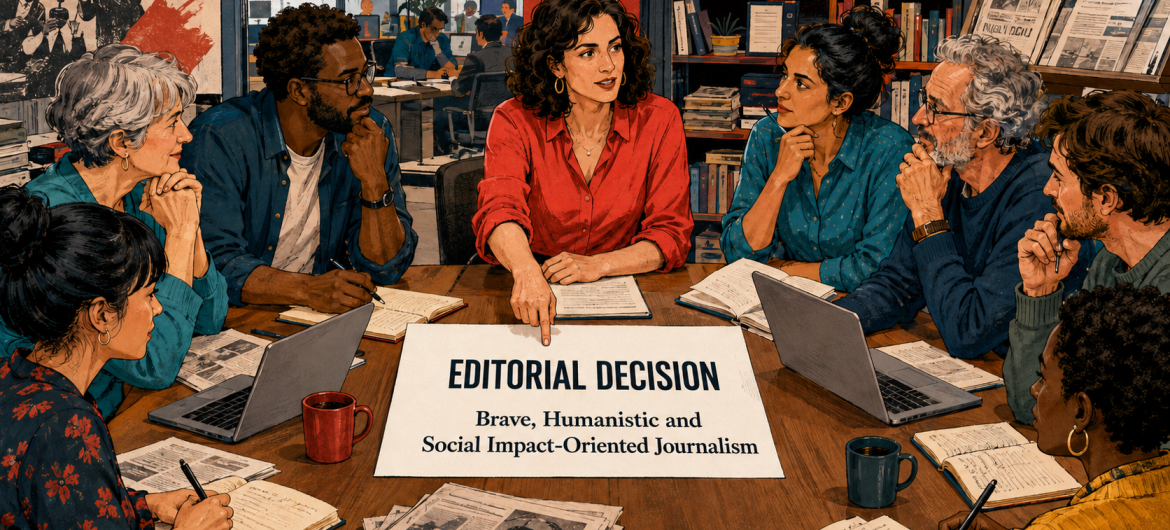
Journalism must be refocused on meeting three basic requirements, and this depends on editorial decisions.
These days, public debate continues to focus on the responsibilities surrounding the tragic death of Professor Jason Arday, following pressure from both the media and social media—pressure that he himself had stated on several occasions he found unsustainable. The role of the media remains crucial, and dodging the issue is no longer tenable. In our case, at DF, you’ll always find people, journalists, and media outlets that are committed to improving journalism and its service to society. To achieve this, we must move forward with a solution that includes three basic requirements: 1) Dialogic accountability, 2) Freedom and non-subjugation, and 3) Investigation, yes, but with humanity and social impact.
First, accountability should not be a mechanism applied in hindsight, but rather one that applies before, during, and after coverage. Throughout this process, a silenced truth can finally emerge without fear. As noted in some British newspaper articles, our profession has a weakness: it is very uncritical of itself; it is highly critical of all other professions, but not of its own. In fact, we’ve seen this on several occasions: when a colleague engaged in self-criticism, they faced attacks on social media or social ostracism, proving the saying, “The cobbler’s children have no shoes”. For this reason, one of the primary criteria is the need for constant accountability, which should be based on dialogue. As Camus said, what concerned him most was that the rush to inform would come at the expense of reporting well, and if Camus were alive today, he would surely see how that warning is unfortunately coming true all too often. That is why it is important to move away from corporatist models in the journalism sector toward models more suited to the 21st century, where the staunch defense of the indefensible no longer has a place. For journalism to be excellent, it must foster dialogue within the sector with other stakeholders and with the public—just as is demanded of both science and business—overcoming the fear of intrusion; international ethical standards are what must be applied, not other interests. The good news is that more and more professionals are daring to break that silence, and we see this in the self-critical reflections of some journalists.
Second, freedom should not be confused with subjugation to the worst values, justified by supposed economic benefits. The immediate reaction whenever there is a push to regulate the press in any way is that alarm bells go off: the fear that press freedom will be violated, and any self-critical reflection can come to be perceived as a threat. This is how stagnation takes hold, when it should be the opposite: we improve press freedom when we improve journalism based on criteria of informational quality, social impact, and humanism. Albert Camus, a journalist who was very active in the French Resistance—even contributing to underground media at the risk of his life—warned in his editorial “Critique de la nouvelle presse”, published just as the press was liberated from Nazism and its censorship, that regaining freedom was not enough to produce good journalism. He thought of all the journalists in the Resistance who had risked their lives to regain that freedom, and for that reason he always criticized the press’s dependence on money, because it led to a loss of moral standards, a succumbing to sensationalism, and practices unworthy of journalism. Later, in the 21st century, Filipino journalist Maria Ressa, 2021 Nobel Peace Prize laureate, denounced how platforms amplified hate speech and misinformation, noting that this posed a risk to our societies. If we add to this media coverage that is not guided by ethical standards but rather by a subservience to money or power, the amplification spreads even faster than on social media; therefore, the combination of the two can even cause irreparable harm to people’s health and lives. We must report the news, yes. But not just any way. As Kapuściński said, to be a good journalist, one has to be a good person, as he wrote in his book This Is Not a Job for Cynics and one must never lose sight of the principle of humanity; or, as stated in the international ethical principles of the Ethical Journalism Network, journalists must not cause harm.
And finally, investigate, yes, but with humanity and social impact. Of course, it’s necessary to investigate, but not just in any way. Anyone, inside or outside the field of journalism, knows that if one publishes a photo of the person, their first and last name, and a headline that already implies condemnation, the narrative is clear: they’ve already been sentenced. And that verdict was already circulating on social media and in the media when the University of Cambridge had not yet conducted its investigation or issued its conclusions. But Jason Arday had already been condemned; that is unfair, and it must be said loud and clear. Therefore, we need to improve the way investigations are conducted and how the results are translated into the actual writing of a news article. It does no good to tear people apart with the stroke of a pen; one cannot write without human sensitivity. Many articles published about Arday resembled the typical schoolyard where rumors, accusations, and ridicule are shared. Anyone who looks into it can see that; that’s why some British journalists insist on two criteria: proportionality and humanity. But it’s too late once the tragedy has already occurred; it must happen beforehand to prevent it. The harsh truth is that it could have been prevented; while it certainly wasn’t the only factor, it was a decisive one. There’s no point in rushing, or using the excuse that we don’t know, because we’re all aware that this is an editorial decision, and when he said “enough,” that he couldn’t take it anymore, the reaction should have been to respect his decision and stop kicking him when he was down. What new information was there? None—excuse me, but that’s not journalism. How is the criterion of humanity being met here? It hasn’t been met in either the supposedly right-wing or the supposedly left-wing media.
In light of the above, it is necessary to give greater visibility to and further promote journalistic investigations that are truly guided by social impact, humanism, and excellence, that do not bow to utilitarian criteria of any kind.
Urgent change is needed. Every contribution from the sector and the public to get us back on track is crucial.
In the case of DF Diario Feminista, an editorial decision has been made to create a special section to highlight the contributions of journalists who, through their investigative reporting, have contributed to social change and have continued to champion freedom and human rights, without yielding to the pressure of money or any other form of power, whether from the right, the left, the center, or any other ideology.
To that end, we must remember the journalistic works that do courageously meet the expected criteria, even overcoming pressure from the media sector itself. Tomorrow we will launch the Brave Journalism section, where we will publish weekly articles focusing on the contributions of journalists from all eras and places—both women and men, as well as those of other genders—who have used their investigative journalism to bring about social change and improve people’s lives, from a humanistic and professional perspective.
👀 Visitas: 98
Periodista colegiada. Directora de DF Diario Feminista. Científica y profesora de la Facultad de Ciencias de la Comunicación de la UAB.