The recently finished International Multidisciplinary Conference on Educational Research, held on July 2 and 3 in Bilbao, served as a benchmark for such important topics as the one addressed in the panel titled “Research in Light of the Recent ‘Upstander’ Approach to Child Sexual Abuse Materials.” During the panel, speakers Ane Olabarria, Alba Crespo, Antonio Carrón de la Torre and Esther Roca presented a comprehensive discussion on how to prevent and address child sexual abuse (CSA) based on their respective areas of expertise.
Ane Olabarria began her presentation by sharing alarming statistics on the incidence of child sexual abuse worldwide and reminded the audience that, behind the data, there are still girls and boys who are suffering. She emphasized that this is not something that only happens on the other side of the world, but is present in our own communities, families, and classrooms. Child sexual abuse is a scourge that exists right here among us, one that is often even legitimized. She shared several examples of this, such as the tweet by journalist Samantha Villar cheering “Way to go, Torbe!” in 2011, even though it was already known that in 2008 Ignacio Allende had been convicted of corruption of minors for recording a pornographic video of a girl under 16. Olabarria, a native of Azpeitia, referred to the case of the doctor who was recently arrested after more than 110,000 child sexual abuse files were seized from him. The Azpeitia native proudly highlighted the significance of the fact that, even though this is a widespread problem in all contexts, her community has taken a stand and spoken out. Most media outlets have reported the story in a way that leaves their audiences with the impression that Azpeitia has a problem while other places do not. The speaker’s message, however, has the exact opposite effect: “We need many more people and communities to want to be ‘upstanders.’”
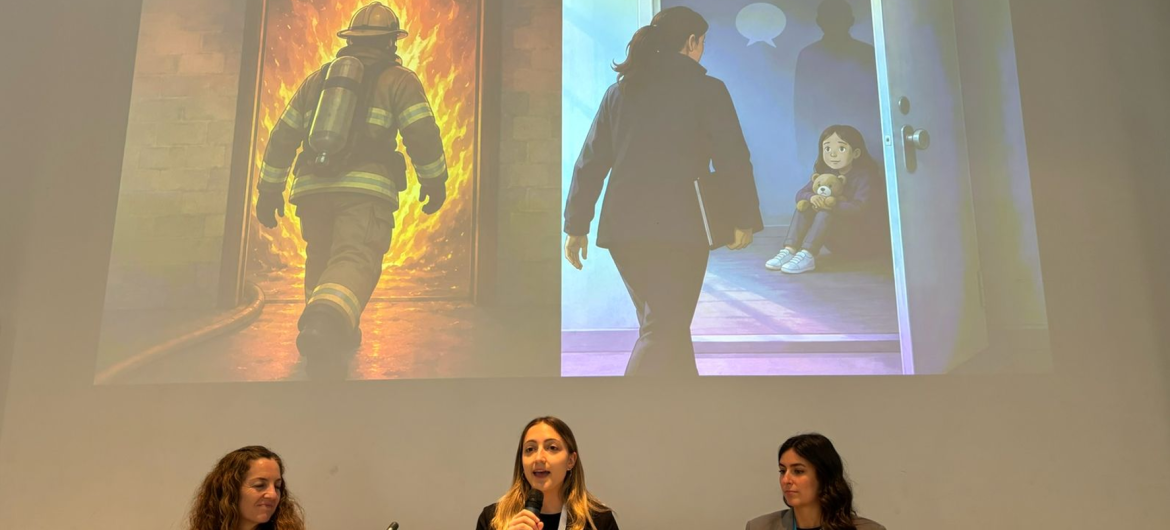
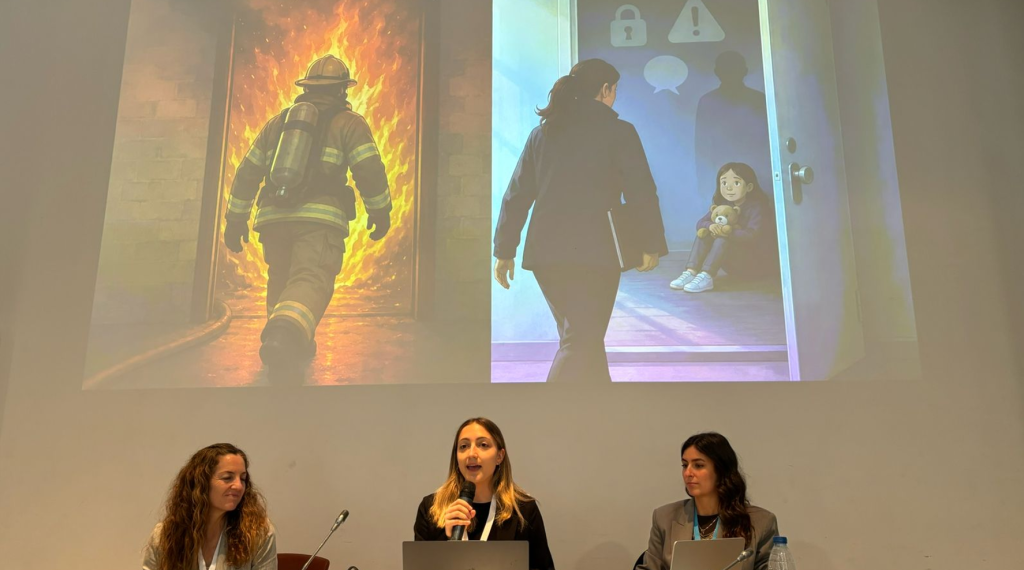
Alba Crespo then explained that support for victims from others is one of the main protective factors, and it is known that such support is no longer given, among other reasons, because of the fear of suffering isolating violence. Crespo presented some research in the field of health that shows the impact violence has on the health of those who offer support, as well as on the victims themselves, and therefore why it is crucial to know which actions have been shown to prevent and overcome isolating violence. Crespo reminded us that all too often, when people are aware of a case of child sexual abuse and want to do something to stop it, those around them try to dissuade them: “don’t get involved,” “it’ll end badly for you,” etc., and she shared the following reflection:
A firefighter who risks the consequences by entering a burning house isn’t told “don’t put yourself in danger”; other firefighters are there to help them, they don’t look the other way. The very few people who risk terrible reprisals to save girls who are being abused are told “don’t put yourself in danger”; others look the other way.
Crespo gave us a moving conclusion to her speech by reiterating her commitment to ending child sexual abuse through beauty, an essential element in its eradication. Accompanied by a beautiful photo, she shared a memory of a dinner from years ago during which a researcher said he would never remain silent in the face of child abuse, and that anyone who wanted to should do the same—even knowing that the repercussions for speaking out would be severe.
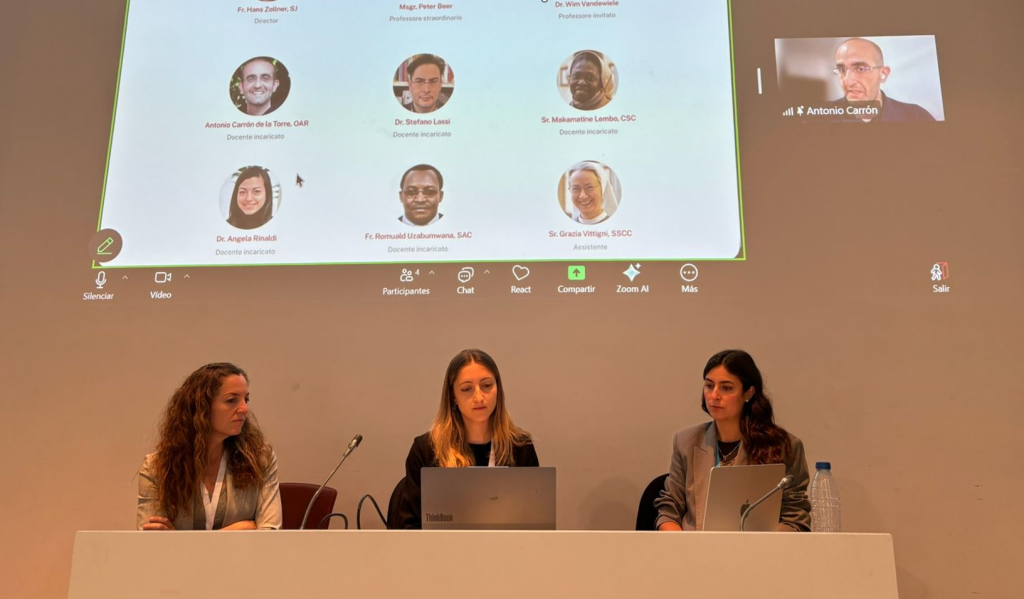
Third, Antonio Carrón de la Torre acknowledged that, indeed, the Church as an institution is not immune to this problem. Carrón de la Torre explained that since Pope Francis’s Papacy, there has been a shift in how these issues are addressed, one that prioritizes people over the institution, with a profound and comprehensive reform in this regard. The current Pope Leo XIV has taken up this cause by addressing the impact of artificial intelligence on minors, which entails a redefinition of relationships among them and also regarding CSA, since we currently find that it can occur with or without physical contact. The speaker announced the upcoming publication of the Pontifical Commission’s 2024 Annual Report, which consistently draws on ideas from different continents to develop measures for the protection of children.
The panel concluded with a presentation by Esther Roca, who focused on the school as a setting for fostering upstanders against child sexual abuse. Roca explained some of the most common myths that have taken hold in schools and are most harmful to children’s sexual-affective education, greatly hindering the prevention and recovery from child sexual abuse. Roca reminded us that schools play a central role in preventing child sexual abuse because they are the institutions through which all children, in all their diversity, pass; it is also the age range during which they are most vulnerable to abuse and the critical years for learning to respond to violence or take action against it.
👀 Visitas: 52