
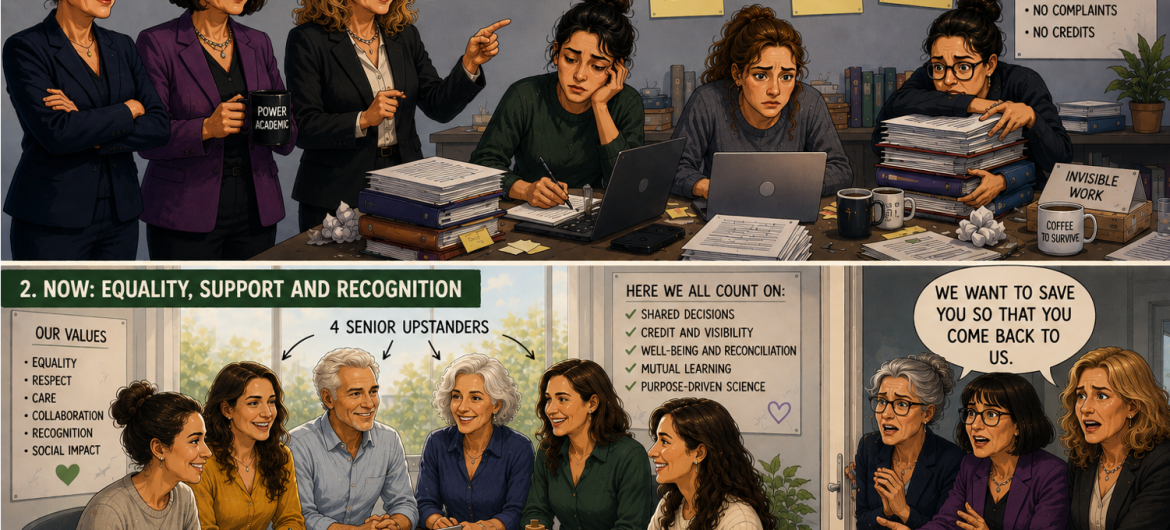
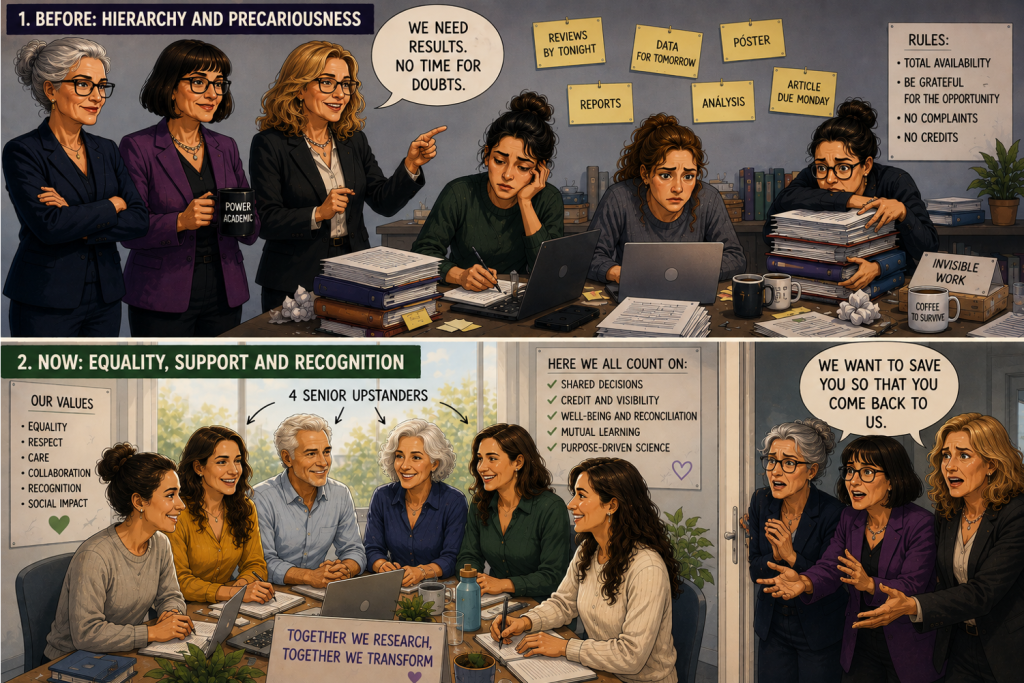
This article presents the testimony, reflection, and first-person analysis of Garazi López de Aguileta, one of the researchers affected by the events referred to. In this text, she analyzes the role of upstanders, the support received, isolating violence, and the double standard she identifies when some people move into positions of power.
According to what a journalist has published, the people attacking us today do not want the upstanders who support us to continue treating us as they treated them when they were the ones reporting situations they considered unjust. In their own words, they want to prevent «behaviors that could continue occurring with younger members.» Yet the behaviors these now senior academics describe are precisely the ones they themselves directed at us, and which the upstanders have never directed either at us or at them. But the quoted sentence is true—perhaps the only point on which we agree: what they wanted for themselves, they do not want for us.
The upstanders who support us today also supported, for years, those who now remain anonymous. They did so when those women sought help because they said they were experiencing situations of abuse or inappropriate treatment. They listened to them, defended them, and played a decisive role in enabling them to develop their academic and professional careers. Today, they hold highly senior and secure positions thanks to the support they received when they were young academics in precarious positions and in a situation of vulnerability.
The situation changed when, in 2023 and 2024, we were the ones who said that we were experiencing alleged inappropriate behavior on the part of some of those former young precarious academics, who had by then become established scholars. Those who had once considered it invaluable to receive support from the upstanders when others behaved inappropriately toward them no longer considered it acceptable for other young academics in precarious positions to receive exactly the same support when they were now the ones allegedly behaving inappropriately toward us.
At the end of 2024, regulations were drafted with the aim of preventing the continuation of those inappropriate behaviors. From that moment on, those who had by then become established senior academics began denying that we had even filed complaints against them and began attacking the upstanders who support us.
It is difficult not to see an obvious double standard in this. The very same support that was celebrated when they received it became the object of criticism when we became its recipients. That is why it is surprising that this support is now portrayed as though it constituted inappropriate behavior. For many years, they strongly criticized the person they considered responsible for the alleged sexual abuse of a minor. However, since the end of 2024, according to the observable facts, they have allegedly begun collaborating with that same person in order to challenge the upstanders who support us.
For those who do not have accurate information about this matter, their statement gives the impression that they want to save us. Many people have wanted to «save» us young women without our consent. Who gave them permission to try to «save» us, and to attack us as they do when we refuse to submit to their wishes?
No, thank you.
That was the principle that enabled many of today’s senior women academics to build their careers. It is the very same principle that we claim for ourselves today. If it was fair then, it must also be fair now. Narratives are easy to invent; the facts are very clear, and so is the evidence supporting those facts. Consistency requires applying the same standards to everyone, regardless of who currently occupies a position of greater power.
👀 Visitas: 95

PhD de la Universidad de Wisconsin-Madison. Soprano miembro de Opera Project.